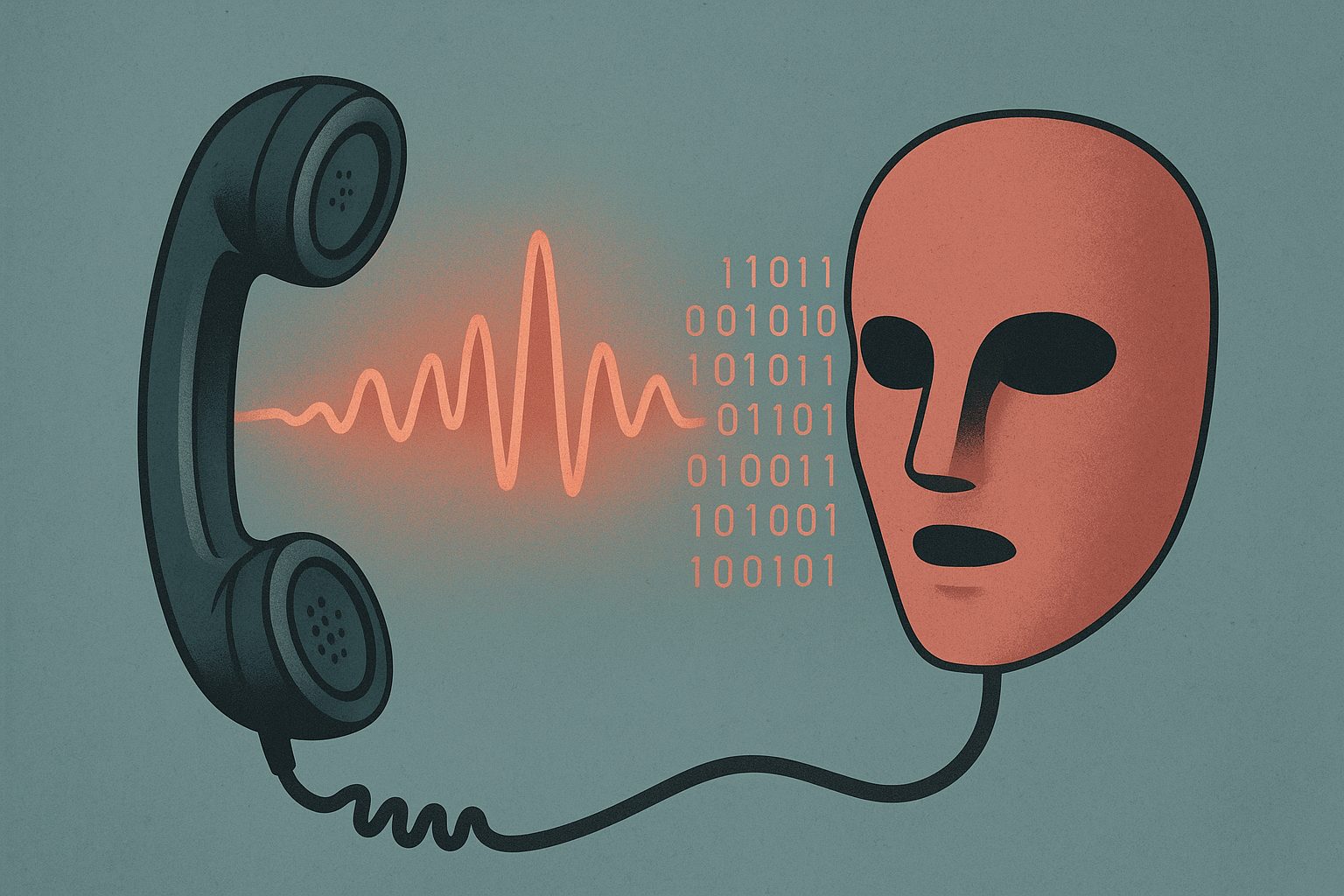
AI voice cloning scams use artificial intelligence to copy the voice of someone you know, then call you pretending to be them, usually in an emergency, and ask for money. A few seconds of audio from a social media video can be enough to make the copy. This guide explains how AI voice cloning scams work, the warning signs, and the simple steps that stop them.
How AI Voice Cloning Scams Work
Voice cloning tools learn the sound of a person’s voice from a recording, then generate new speech that sounds like them saying anything. Security firm McAfee found that a clip of just three seconds could produce a clone with an 85% match to the original speaker.
Scammers find that audio easily: videos on TikTok, Instagram, Facebook or YouTube, voicemail greetings, podcasts, or a short phone call where they get you talking. Then the scam usually follows a familiar script:
- A panicked call. You hear a loved one’s voice, often a child or grandchild, saying they have been in a car accident, arrested, kidnapped or stranded abroad.
- A second voice takes over. A “police officer”, “lawyer”, “doctor” or “kidnapper” explains what must be paid, and fast.
- Secrecy and urgency. You are told not to hang up, not to tell anyone, and to pay immediately.
- Hard-to-trace payment. Wire transfer, gift cards, cryptocurrency, payment apps, or a courier who comes to collect cash.
It works because the voice bypasses your doubts. Research cited by Fortune found that when a voice sounds like someone we know, we lower our guard and believe what we hear.
Real Cases
- In California, a mother wired thousands of dollars over several hours after a caller played what sounded like her daughter’s voice and claimed she had been kidnapped. Her daughter was safe at work the whole time.
- In Hong Kong in 2024, a finance worker paid around HK$200 million (about US$25 million) after a video call with what appeared to be the company’s chief financial officer and colleagues. Every other person on the call was a deepfake, according to Hong Kong police.
- Before a 2024 US primary election, voters received robocalls using a cloned voice of President Biden telling them not to vote.
The FBI has warned that these scams are becoming harder to detect, and says Americans lost more than $893 million to AI-related scams in a single year.
Why Voice Cloning Is So Easy
The tools are cheap or free, and many require almost no proof that you have permission to copy a voice. When Consumer Reports tested six voice cloning products in March 2025, four of them let testers clone a voice from public audio with little more than a checkbox saying they had the right to do so.
That means anyone who posts videos online, which is most people, has given scammers enough material. You cannot fully prevent a clone of your voice. What you can control is how your family responds to a call.
A voice used to be proof of who you were talking to. Now it is just another thing that can be copied. Why identity online is so easy to fake is the subject of Wes Kussmaul’s Escape the Plantation, and you can get a free copy at the end of this article.
Warning Signs of an AI Voice Scam
- Extreme urgency. You are pushed to act before you can think or check.
- Instructions to stay on the line or keep the call secret from other family members.
- Unusual payment methods such as gift cards, cryptocurrency, wire transfers or cash collection.
- A call from an unknown number, or a familiar number that has been spoofed.
- Odd details in the voice: strange pauses, flat emotion, or phrases your loved one would never use.
- Avoiding questions. The caller cannot answer simple personal questions, or changes the subject.
Do not rely on spotting a fake by ear alone. Clones keep improving, and panic makes everyone a worse judge. The same applies to video, which our guide Is This Video AI Generated? covers.
How to Protect Yourself and Your Family
- Agree a family safe word. Pick a word or phrase only your close family knows, and never post it online. If someone calls claiming to be in trouble, ask for it. A scammer with a cloned voice will not know it.
- Hang up and call back. End the call and ring your loved one on the number you already have for them. Also try someone who is likely to be with them.
- Slow everything down. Real emergencies can wait the two minutes it takes to check. Scams cannot.
- Never pay by gift card, crypto or wire to someone who has called you out of the blue.
- Limit public audio. Make social media accounts private where you can, and think twice before posting long videos of children talking.
- Talk to older relatives. Grandparents are a common target. A five-minute conversation about this scam can save them a great deal of money.
What to Do If You Get a Call or Have Already Paid
- Contact your bank immediately if you sent money. The faster you act, the better the chance of stopping the payment. In the UK, you can call 159 to reach most banks’ fraud teams safely.
- Report it. In the US, report to the FTC at ReportFraud.ftc.gov and to the FBI’s Internet Crime Complaint Center at ic3.gov. In the UK, report to Report Fraud at reportfraud.police.uk. Elsewhere, contact your national fraud reporting service or local police.
- Warn your family, because scammers who have your relative’s voice may try others.
- Keep evidence: the number, time, what was said and any payment details.
Voice Clones and the Wider Problem
Voice cloning is part of a broader shift: faces, voices and videos can no longer be trusted on their own as proof of who someone is. Our guide What Is a Deepfake? explains the technology, and Misinformation vs Disinformation shows how deliberate fakes spread. The same tools used to steal money from families are also used to put false words into politicians’ mouths.
Frequently asked questions
How do AI voice cloning scams work?
Scammers take a short recording of someone’s voice, often from social media, and use AI to generate new speech that sounds like them. They then call that person’s family, fake an emergency, and pressure them to send money quickly.
How much audio do scammers need to clone a voice?
Very little. Testing by McAfee found that around three seconds of audio could produce a convincing match, and the FBI warns that a few seconds from social media can be enough.
How can I tell if a voice is AI?
Listen for odd pauses, flat emotion and unusual phrasing, but do not rely on your ear. The safest test is to hang up and call the person back on a number you know, or ask for a family safe word.
What is a family safe word?
It is a word or phrase agreed in advance by your family and never shared online. Anyone calling in a genuine emergency can say it. A scammer using a cloned voice will not know it.
Where do I report an AI voice scam?
In the US, report to ReportFraud.ftc.gov and ic3.gov. In the UK, report to Report Fraud at reportfraud.police.uk. If you sent money, call your bank first.
Related reading
- What Is a Deepfake? How to Spot One and Protect Yourself
- Is This Video AI Generated? How to Check
- Is This Image AI? How to Tell, Plus Free AI Image Detectors
- Misinformation vs Disinformation: The Difference Explained
When a voice can be copied in seconds, hearing someone is no longer proof that it is them. Wes Kussmaul’s Escape the Plantation explains why the internet has no reliable way to prove who you are dealing with, and how identity you own and control could keep people accountable but anonymous, so fakes lose their power. Enter your email below to get your free copy and follow Goebbelsology’s work on spotting manipulation.